
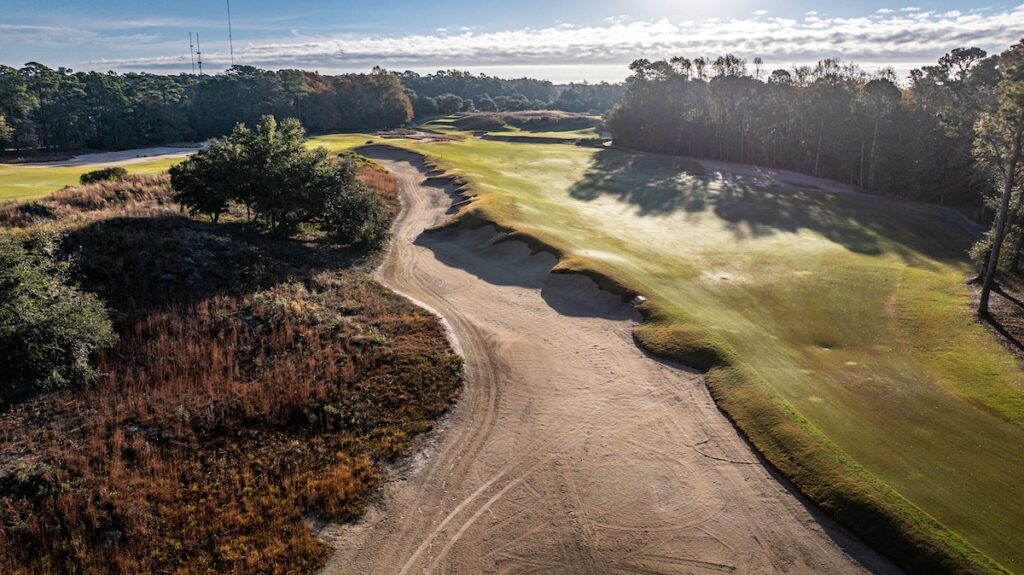
Long before Mike Strantz became a cult hero in golf architecture circles, he was walking sandy ground in Pawleys Island with a paint gun, a handful of flags, and a clear vision in his mind.
Across the road from one another sit Caledonia Golf & Fish Club and True Blue Golf Club — two courses that reflect different chapters of Strantz’s creative life yet are forever linked by his restless imagination.
Mike Jones remembers it vividly.
Jones, now with Maverick Golf Design, worked as a shaper for Strantz at True Blue. He wasn’t there for the original construction of Caledonia, but while True Blue was being built, Strantz frequently crossed the road to tweak and refine his first solo design.
“In his head, a golf course was never finished,” Jones said. “He was always looking for something he could improve.”
Caledonia, Strantz’s first solo design, was crafted from a relatively modest 120-acre canvas. It is intimate, strategic, framed by centuries-old oaks and Lowcountry character. True Blue, built a couple years later, was entirely different — expansive, muscular, unapologetically bold.
Strantz designed without overreliance on numbers or grid systems. Where many architects use tightly plotted grading plans, Strantz relied on instinct and artistry.
“He’d sit on a tee box with a sketch pad and draw the hole,” Jones said. “Just a pencil drawing — the fairway lines, the bunkers, the horizon lines. Then he’d hand copies to the three of us shapers, and we’d build it.”
There were no endless flags marking five-foot grids. No dependence on rigid measurements.
“The only time we really used numbers was for drainage,” Jones said. “Everything else was visual. When we thought we were close, we’d use a smart level just to make sure we were in a playable range.”
That approach made Strantz rare.
“There’s very few people who are true artists that can draw it and see it like that,” Jones said. “Most depend on photos and numbers. Mike didn’t.”
Strantz was deeply hands-on. Living in Charleston during the True Blue build, he would drive up each evening — often the first one on site and the last to leave. Dressed in blue jeans and a T-shirt, he’d move across the property, framing corridors, painting bunker edges, walking holes from green back to tee to establish perspective.
On one occasion, during installation of the pump station at True Blue, Jones and Strantz worked nearly straight through the night laying pipe in sandy soil that kept collapsing from groundwater pressure.
“We started at 7 in the morning and worked until 3 the next morning,” Jones recalled. “Mike was right there the whole time. Digging, banding pipe, tightening bolts. Then we went home, showered, took about an hour nap, and came back.”
That was Strantz. Fully invested.
His commitment only deepened in later years. During construction of his final projects — including Monterey Peninsula Country Club — Strantz was undergoing chemotherapy. Jones would sometimes drive him to treatments, wait, then bring him back to the site.
“He’d get out of the truck with his flags and paint gun and go right back to work,” Jones said. “He loved being on a golf course that much.”
Strantz’s style evolved dramatically after Caledonia. Where Caledonia whispers, True Blue roars. Where Caledonia fits gracefully into its Lowcountry setting, True Blue stretches and rolls with dramatic scale. Yet both courses share a common DNA — strategic angles, artistic shaping, and a refusal to be ordinary.
“He never wanted to copy himself,” Jones said. “He would block out what he’d done before and start fresh.”
Today, architects may borrow from Strantz’s bold shaping and visual drama, but those who worked beside him know what truly set him apart.
Vision.
“If you didn’t have that vision, you couldn’t understand what he was doing,” Jones said. “But he knew. He could see it before it was there.”
Across the road in Pawleys Island, that vision still lives — in two courses that tell the story of an artist who never stopped creating.